Irrigation System Installation and Repair
Irrigation contractor for the Canberra region
.jpg/:/rs=w:1209,h:907)
Irrigation contractor for the Canberra region

Canberra Irrigation specialise in both repair and installation of garden irrigation systems. Canberra Irrigation is run by me, Tom Street. I’m a passionate gardener and my appreciation of the value of automatic irrigation systems for Canberra gardens is why I run this business. I can install, repair, or replace any type of home irrigation system, including sprinkler systems, drip irrigation, micro-sprays, solenoid valves, and irrigation controllers. I aim to deliver water-efficient, durable solutions in a cost-effective way. I work throughout the ACT and near surrounds.
Repairs can range from a few hundred dollars to many thousands depending on the condition of the system.
The cost of repairing an irrigation system can vary enormously. Sometimes the problem is straight forward and requires a $500 quick fix. In other cases the system may be in very poor condition and repairs can become extensive or require total replacement of the system costing many thousands of dollars.
Because old and poorly maintained systems reveal problems progressively — fixing one fault sends water further into the system, exposing the next — it is not possible to quote on repairs. You can use the information below to consider what sort of cost you might be looking at to repair your system.
The two biggest factors are how the system was originally installed and how it has been maintained.
Best case scenario
A relatively new system that was installed properly, is accessible and has been used and maintained. When faults appear in systems like this they are usually much more straightforward to diagnose and repair. These are the cases where repairs provide the most unambiguous value.
Worst case scenario
Some properties have irrigation systems that are very old, badly deteriorated, buried under gardens, and/or were installed poorly to begin with. In these situations the system will almost certainly contain multiple hidden leaks, broken pipes and failing components. In some cases parts of the system may also be difficult or impossible to access.
Many of these problems only become visible once the system is running again.
Once the system is turned on it is common for additional faults to appear. Repairing the system properly can sometimes involve significant work and expense, and in some cases replacing large sections of the system — or replacing it entirely — is the most practical option.

One of the biggest factors affecting irrigation repair costs is accessibility.If components such as solenoid valves, pipe junctions and wiring are easy to locate and reach, repairs can often be completed quickly. When these components are buried deep in gardens, hidden under roots, paving or garden beds, or their locations are unknown, even simple repairs can take many hours.
For example, replacing a solenoid valve that is easily accessible can sometimes take as little as 15 minutes.
Replacing a valve that is buried underground, covered in roots, or in an unknown location can take many hours or even a full day to locate and repair.
What could otherwise be a straightforward and inexpensive repair can become very expensive if accessibility is poor.
The image on the right shows some old (grey) solenoid valves attached to a wall, one of which had failed and begun leaking. The easy accessibility of these valves made the repair quick, saving the customer money, compared to a system where valves are buried deep throughout the garden.
One of the best things a customer can do to reduce repair costs is locate broken components and dig them up so they are fully accessible
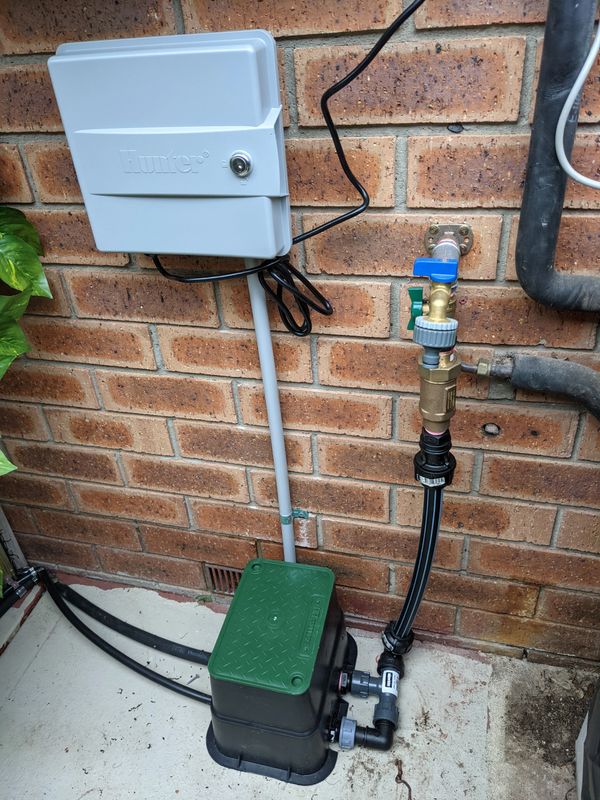
Access is the main thing to keep in mind. Thinking ahead ten, twenty and thirty years to how a system will be to maintain will save a lot of money in the long run. The image to the right shows a new system that I installed. The valves are inside the green lidded box. The irrigation controller and water source are immediately above. This sort of simple system allows for inexpensive installation and straightforward maintenance of the fundamental components of your irrigation system.
Unfortunately I often come across overly complicated systems, often installed by non-specialists, with a setup that is neither helpful to the operation of the system or the future cost of its maintenance.
On the right is an example of some solenoid valves that were completely entangled in tree roots. Replacing these valves was an expensive and painstaking process. The tree roots needed to be carefully removed, not only to enable access to the valves but also to prevent the risk of further damage to valves, pipes or wires.
Burying valves deeply in the ground, especially near plants that will grow substantially leads to leads to expensive and time consuming repairs down the line.

Don't put valves or pipes near to plants that will grow much larger. This system you can see in the photo needed to be totally replaced due to a simple error placing the valves next to a tree and running the pipes inaccessibly under concrete.
If you have a handy external powerpoint a mains powered controller is generally the best option.
- They fit neatly and accessibly on the wall.
- You don't have to change batteries.
Basic models (such as Hunter X Core) will run irrigation automatically according to a schedule and will cost about $400 just for the controller not including installation or any other part of the irrigation system.
Internet connected models (such as Hunter Hydrawise) will automatically adjust for weather and season. You control these from an app on your phone whereever you are. They cost around $900. Again just for the controller.
You will need a power point to install the controller. Preferably an exterior power point which is not overly exposed to baking midday or afternoon sun in summer, which can damage controllers. How easy it is to run wires from controller to water source and connect water source by pipes to areas to be irrigated is a very important factor in the cost of installation.
If a power point is unavailable and too difficult to install battery operated controllers are available. The Hunter Node mode as in the photo are very reliable but do need to have the batteries changed about every 12 months. They also don't connect to internet and don't adjust for weather or season.
For internet connectivity with weather and season automatic adjustment LinkTap battery operated controllers seem to be the best (As a bonus they area Canberra owned business!).
Bushes, flowers and trees are generally best watered using drippers/dripper pipe as this is more water efficient, more reliable, requires less maintenance and reduces weed germination. Drippers delivers the water directly to where it is needed and assists in deeper penetration of soil moisture. Micro-sprays spread water over plant leaves and soil surface which causes greater evaporative loses, which can be severe in the ACT's dry climate . Drippers on the other hand apply water slowly from a single point source near each plant allowing water to permeate down deeper into the root zone. This also minimises moisture on the soil surface reducing the germination of weeds. Micro-sprays also regularly get clogged, broken and tangled requiring maintenance. Also, as plants grow they can block the spread of water by micro-sprays meaning the effect you initially got is not what you achieve down the road. Brown dripper pipe is now the standard in garden beds amongst professional irrigation installers and for good reason. As the rate of flow from dripper pipe is generally 2 LPH per dripper compared to 50+LPH from micro-sprays (though less numerous) you do need to run dripper pipe for much longer. See 'How much should I water?' Section below.

In vegetable gardens, dripper pipe is generally best for larger plants (e.g. tomatoes or zucchini) that can be planted immediately adjacent to each dripper,(every 30 cm). For smaller plants and plants you don't want to go to seed (e.g. lettuce, coriander etc) non-misting micro sprayers make it more certain all plants will get water right from planting. However, micro-sprays can be considerably less efficient and encourage more weed growth, especially in narrow beds. Dripper pipe can still be a good option even for more difficult leafy green vegetables and is what I use in my vegetable garden with good results.
Lawns need water over their entire surface area they are generally irrigated using pop up sprinklers. Closely spaced subsurface dripper pipe is another option. Subsurface dripper systems are more water efficient. On the other hand they are more expensive to install, can be damaged by shovels and garden forks (generally it's installed 10cm deep) and make initial lawn establishment more difficult. Most importantly it's much harder to tell if they are working. Probably a better way to increase water efficiency of lawn watering is to choose more drought tolerant grass species such as buffalo grass or native Australian grass species like Wallaby or Weeping Grass.
Subsurface irrigation was mandated by the ACT government during critical low water storage levels due to drought in the early 2000s. Water storage has been greatly increased since then to such an extent that water conservation measures wouldn't be needed again for decades. However, the record breaking drought which ended in the bushfires of 2019-2020 came close to requiring the reimposition of water conservation measures and highlights our uncertainty about what the future may hold in this regard. At this stage 2024 with the dams fairly full water conservation mandates, if they are required again, are at least some years of drought away.
Drippers and sprinklers that apply water slowly are generally the best choice.
For drippers I suggest fixed rate drippers, ideally 2LPH and not adjustable ones (as in photo). adjustable drippers are finicky and prone to problems.
For sprinklers Hunter MP Rotator pop up sprinklers are great and the standard in Canberra.
When water is applied slowly it is more likely to penetrate and spread through the soil rather than run off. Another advantage is that the slower drippers or sprinklers emit water the more drippers and sprinklers you can run at one time off a single pipe.